Eiger, Mönch and Jungfrau

The mystery behind the names of the ice giants

The snow-capped trio of the Eiger, Mönch, and Jungfrau in the summer.
History

“Oh look, look!” cried Heidi in great excitement. “All of a sudden they’re turning rose-red! Look at the one with the snow, and the one with the high, pointed rocks! What are their names, Peter?” “Mountains don’t have names,” he replied (from Johanna Spyri’s Heidi’s Years of Learning and Travel). The goatherd’s answer comes as a bit of a surprise – after all, mountains do have names. But in Peter’s day, the white peaks had no economic value or use, so nobody bothered to name them.

Large rivers, settlements and valleys were named first – and then, at last, the time had come: our high alpine peaks got their names.

In centuries past, the peaks were seen as barely accessible terrain with no economic value. After all, farmers couldn’t exactly graze their cows on the Eiger. So people had absolutely no need to name them – unless, of course, the peaks served as landmarks for finding their way.

The word “Berg” (mountain) referred to alpine pastureland and mountain passes – but hardly ever to peaks.

Many of today’s mountain names have been documented for several centuries. However, they didn’t always refer to the same peak, as the example of the Mönch shows. A name first had to be officially established – until then, a peak could go through several name changes.

It was the boom in alpine tourism that brought consistency, with peaks being named uniformly. The Alps were discovered as a travel destination from the Renaissance onwards, but the first ascents of the high alpine peaks didn’t take place until the 19th century.

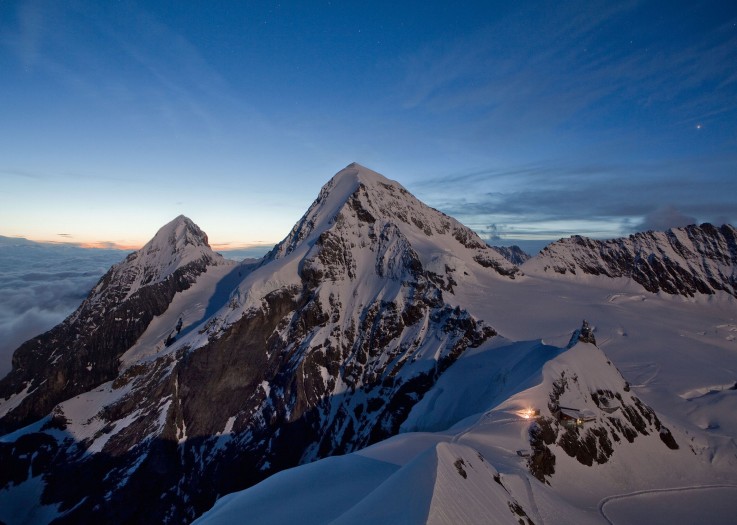
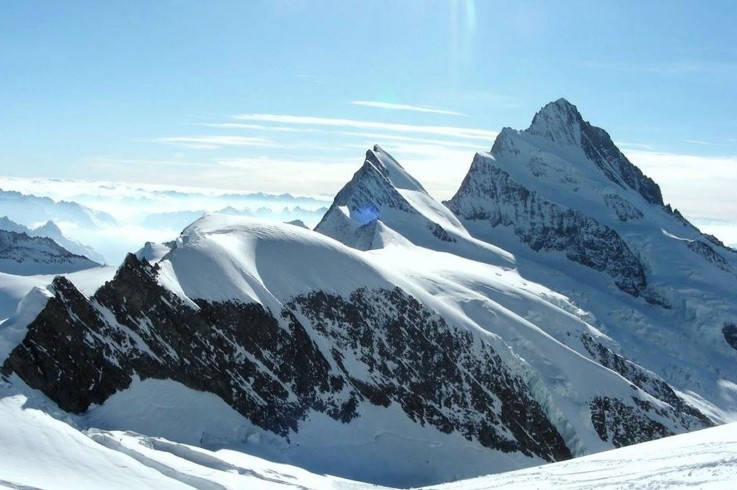
Mountains and mountain ranges are named after their size and shape (Breithorn, image 1), their geology (Schwarzmönch, image 2), their location (Mittaghorn, image 3) or people (Agassizhorn, image 4) – but also after the weather, vegetation, wildlife and myths.

Nine

four-thousanders tower over the Bernese Alps – but only two of the famous trio are among them.
Night shot of Lake Bachalpsee near Grindelwald First

But now, let’s talk about the famous trio.

For the sake of completeness, here are the nine four-thousanders of the Bernese Alps: Finsteraarhorn, Aletschhorn, Jungfrau, Mönch, Schreckhorn, Gross Fiescherhorn, Gross Grünhorn, Lauteraarhorn and Hinter Fiescherhorn.

First, how they came to be – and for that, we’ll put our trust in legend.

Long ago, a family of cruel giants lived on the Wengernalp. They were known far and wide for their wicked nature. One day, a poor little old man in threadbare clothes came along and asked the giants for a sip of milk. But the giants refused and snapped at him that he deserved nothing but water.
Uh-oh, this can’t end well. We can already see trouble coming.

The Wengernalp Railway poses in front of the Wetterhorn. Luckily, there are no cruel giants to be found here these days.

So what became of the wicked giants?

Of course, we were right. Trouble came: the little old man insulted the giants, and they wanted to get their hands on him. Naturally – what giant would be afraid of such a little fellow? But no one knew that the little old man was a mountain spirit, and far stronger than anyone else. Well, tough luck. The giants really couldn’t have seen that coming. The mountain spirit cursed them for their wicked deed. All of a sudden, they began to grow. They grew bigger and bigger, until they turned into solid rock and ice. And that’s how the father became the Eiger, the sons became the White and Black Monk, and the daughter became the Jungfrau. Makes sense. That must be how it happened.

Father, sons and daughter, united in solid rock. Turns out they picked the wrong man to insult.

And there they stand – the giants turned to stone.

Eiger, Mönch and Jungfrau – that order just feels right. It’s etched into our collective memory. We’d never dream of switching it around. It’s perfect just the way it is.
The famous trio of the Eiger, Mönch, and Jungfrau at sunset.

The man-eating giant certainly lives up to its name.

The Eiger is one of the first Swiss high peaks to be mentioned in historical documents. Its first recorded mention dates back to 1252, with the words “ad montem qui nominatur Egere” – although this may have referred to an alpine pasture whose name was later transferred to the peak. We can’t be sure. It then took another half-century for the Eiger to be mentioned in German for the first time, in the words “under Eigere”.

According to popular interpretation, the name Eiger comes from “ogre” – a man-eating giant. Naturally, that brings to mind the lovable Shrek and his trusty Donkey. But unlike Shrek, the Eiger has a fearsome reputation – and its North Face has done an impressive job of earning it.

All roads lead to Rome – or, in this case, to the meaning of the name Eiger.

The first settler below the Eiger is said to have had an Old High German name: Egiger or Agiger. The mountain above his pastures was therefore called “Aigers Geissberg” – Aiger’s goat mountain. That may well be how it happened. Or does good old Latin reveal the true meaning? The Latin word “acer” gave rise to the French “aigu”. Both mean “sharp” or “pointed” – a clear reference to the Eiger’s shape. The third explanation also judges the Eiger by its appearance: the once-common spelling “Heiger” may have come from the dialect expression “dr hej Ger” (“hej” means “high”, and a “Ger” was a Germanic throwing spear). So – option one, two or three? We simply don’t know.

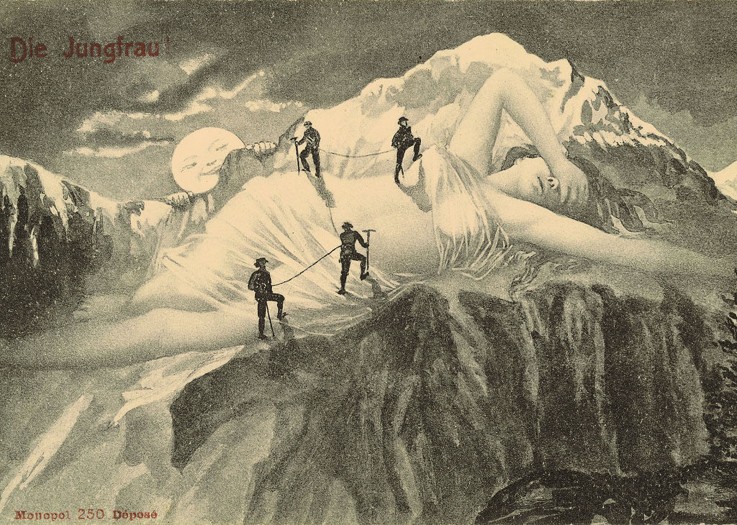
A popular story tells how our “ogre Eiger” keeps trying to lay his lecherous paws on the Jungfrau – the “Maiden” – only to be stopped every time by the Mönch, the “Monk”. Poor ogre … or poor maiden?

to an inexperienced climber who was crawling along the narrow ridge of the Eiger on all fours, trembling.
Karl Molitor
“You can stand up straight, you know – there’s nothing up here to bump your head on!”

There’s hardly another peak whose name is surrounded by so much confusion and uncertainty.

Wedged between the Eiger (3,970 m) with its spectacular North Face and the Jungfrau (4,158 m) with her pretty looks, the Mönch long led a wallflower existence.
It starts with his name – or rather, the lack of one, because for a long time he didn’t have one at all. Well into the 19th century, he went by names such as Eigers Schneeberg (“Eiger’s snow mountain”), Hinterer Eiger (“Rear Eiger”), Kleiner Eiger (“Little Eiger”) or Inner Eiger. Later he became the Weissmönch (“White Monk”), Grosser Münch or Gross-Mönch.

The most obvious explanation would be that the name comes from the monks of a nearby monastery. But no, sorry. At the foot of the Mönch, there were alpine pastures where geldings – known locally as “Münche” – used to spend the summer. So the mountain above these Münchenalpen came to be called “Münchenberg”, and eventually Münch, and finally Mönch.

He didn’t just go by many names – he also had to be measured several times. And, just to keep things interesting, with a different result every time: estimates ranged from as low as 3,976 to as high as 4,114 metres above sea level. Today, he is undisputedly one of Switzerland’s 48 four-thousanders.

4107

metres above sea level is the Mönch’s official height. Measuring it proved tricky, because the Mönch has a summit cap of firn snow that has grown in recent years.
The evening sun illuminates the snow-covered Mönch. The Jungfraujoch Sphinx is visible.

With the third peak of the famous trio, too, we can only speculate about where the name comes from. With a few very rare exceptions, this peak has borne its current name for centuries.

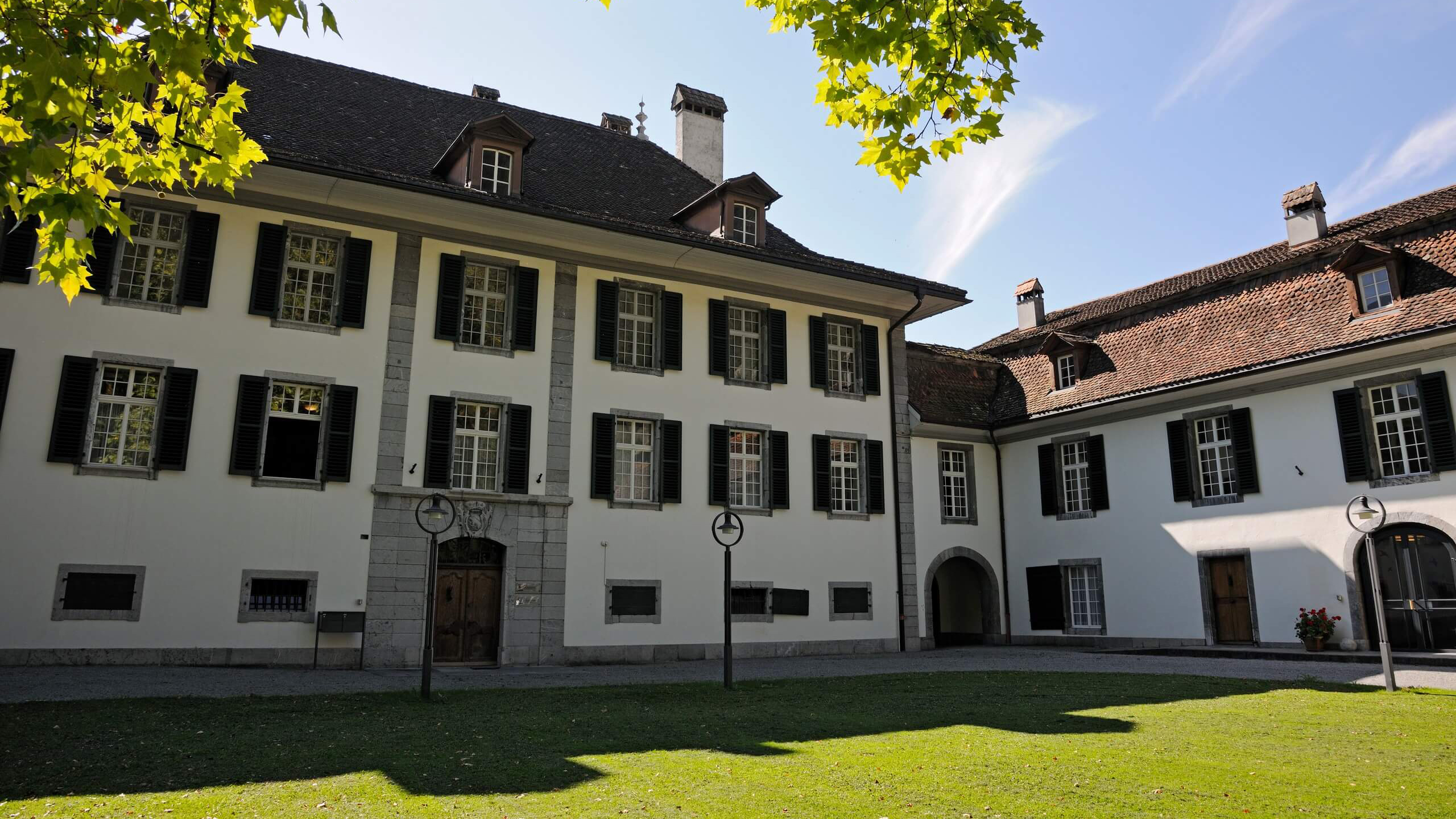
In the 14th century, there were many Premonstratensian double monasteries, like the one here in Interlaken – an order founded on the Rule of St Augustine.

The cloaks, hats and birettas worn by the monks and canonesses were pure white. So we’re happy to assume that the monks of Interlaken came up with the idea of comparing the shimmering white peak to a Premonstratensian canoness – a “Jungfrau”, or maiden.

The peak’s seemingly untouchable nature no doubt played a big part too.

The first definite mention of the name Jungfrau dates from 1577, in Thomas Schöpf’s “Chorographia ditionis Bernensis”. In this work, the author stated firmly that the Jungfrau was a mountain bristling with eternal snow and ice, and therefore completely inaccessible – which is why the locals derived its name from an untouched maiden.

The name would then probably have been transferred from a “Jungfrauenalp” – a maidens’ alpine pasture – to the peak above it.

The Jungfrau Railway makes it possible.

Thanks to the Jungfrau Railway, we can travel straight through the Eiger and Mönch all the way up to Jungfraujoch – Top of Europe, and from the comfort of our seats. True to her name, though, the Jungfrau herself remains out of reach. At least by train.

British writer, painter and art historian
John Ruskin
“The Swiss Alpine peaks sit like children on a great tabletop. The most majestic impressions arise when one of the great peaks steps up to the edge of the table to look down, suddenly revealing its full height above the valley. This is the case with the Wetterhorn and the Eiger at Grindelwald.”

At the end of the day, it doesn’t really matter whether the three peaks owe their names to monks, geldings, canonesses or ancient Germanic words – there’s one thing we can all agree on: the famous trio just looks amazing.

Find out more

Jungfraujoch - Top of Europe
Find out more

Schilthorn-Piz Gloria
Find out more

Photos: Jungfrau Region, Jungfrau Railways
Story: André Wellig
Autumn 2017

Contact

Jungfrau Region Tourismus AG
Kammistrasse 13
CH-3800 Interlaken

Tel. +41 33 521 43 43
info@jungfrauregion.swiss